If you start a successful health tech company, you will end up doing ops work
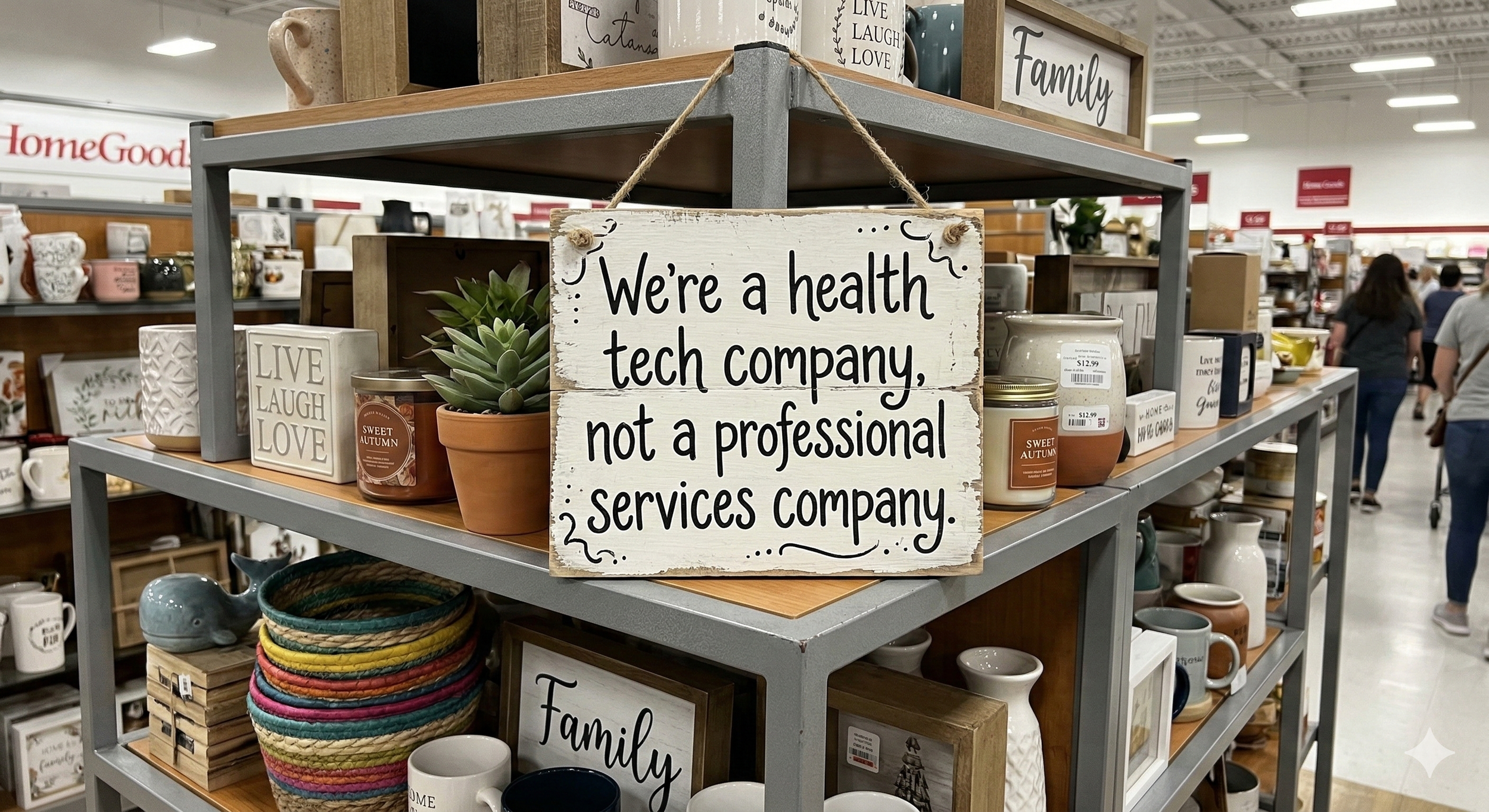
"We're a health tech company, not a professional services company." I've heard it so many times. In a parallel universe there is a Home Goods that sells a little cheugy wooden sign with those words painted on it.
Operations is what you run into when the workflow your product was built for isn't the workflow your customers actually run. You're changing how people work in ways you didn't expect. Those people want to know why you're changing it, then you want to know why they work that way, and bam! You're solving an ops problem.
The CEO of UCLA Health told me how they budgeted for ambient AI scribes by reducing the budget for human scribes. The ambient scribes were a hit, but they ran into an ops problem when they took away the human scribes. Turns out the scribes were doing more than scribing, so to remove them from the equation and not disrupt the clinic flow, they needed a new process. It's easier to add something than take something away. If no one owns the ops work, the technology will not be adopted. If the tech company takes on too much ops work, they get pulled into a lower margin business. There is a sweet spot in the middle and techniques for finding it.
Go on-site before you go remote
Not all clinics work the same way. Not even clinics in the same practice.
Early in my career, I implemented new athena practices on the west coast while I lived in Boston. I'd fly out to California, or wherever the practice was. In the morning I'd do phone calls from my hotel room with clients I was implementing remotely, then I'd hop in my rental car and drive to the practice I was implementing in person.
I learned so much more from the in-person visits. People firmly believe they do things one way, and will tell you, totally convinced on the phone, that something works a specific way: "All of our doctors personally sign every order they place." But when you get to the clinic, you inevitably find that not all of the doctors personally sign every order they place.
Suddenly doctors' inboxes were full of orders that they needed to sign, when previously they were verbally telling their MAs or nurses to fax a prescription or call in a lab. Now what was previously the doctor saying 5 words turned into doctors clicking 5 buttons and filling in additional admin details. The original workflow was built under the incorrect assumption that the doctors signed all the orders. Spending time in a practice shows you what actually happens, so you can build better tech and process and reduce the impact of the ops problem.
Athena rolled out order delegation functionality, so the MAs and nurses could place and send orders from athena and the doctor could approve them en masse. On numerous occasions I turned this functionality on for practices that had been operating without it, and it made them much happier with both athena and with me.
My experiences on-site gave me the insights I needed to do a better job helping my remote clients. Even if I didn't know their exact practice, I had enough reps in different on-site clinics that from phone calls, I could imagine what they were going through and cover 95% of edge cases for an implementation. That on-site experience makes all the difference.
Ask why until it's uncomfortable
When you go on-site, ask why as much as you can. Ask until it is uncomfortable. If you squint your eyes, pause, and make a thinking face in between whys, people will entertain your questions longer than if you have the smirk of a 6-year-old asking why for the 7th time.
You'll start to understand which workflows are clean and which are covering for something else that is messed up. You might be able to solve that problem in another way (if previously the scribes prepped short summaries for docs, the AI can do that too). In the areas of the workflow you're improving, you want to learn about all the people involved, their goals, and their constraints.
Even then, you want to frame with the team that everything won't be perfect the first time and you're going to work together to make it right (and that you've taken extra time to ensure patient safety is pre-addressed as much as possible). Everything works better when it is you and them against the problem, not them holding the problem in their arms as they try to hand it to you.
After a few client visits, you'll figure out most of the edge cases for your solution. You should document these as best practices (this is the best way to use our software) to reduce friction in future rollouts.
If you really want to work in health tech and not have to deal with ops, buy and sell data. But know that eventually, no matter what you do, people will want you to expand your offering until it starts to encounter ops problems. The health tech companies that get traction and improve healthcare aren't the ones with the best product. They're the ones willing to get into the ops mess.