Here's What Happened Last Time athena Made a Big Move into a Marketplace Category
athena announced its own AI Voice and 2-Way Texting functionality (here is my blog about it). That should light a fire under the marketplace partners offering those services. 25 of the 33 companies currently offering Voice AI on the marketplace joined in the last 3 years. They probably don't know that athena has done this before.
The ones who learn from what happened last time will be better positioned for what's coming.
The Self Check-In Precedent
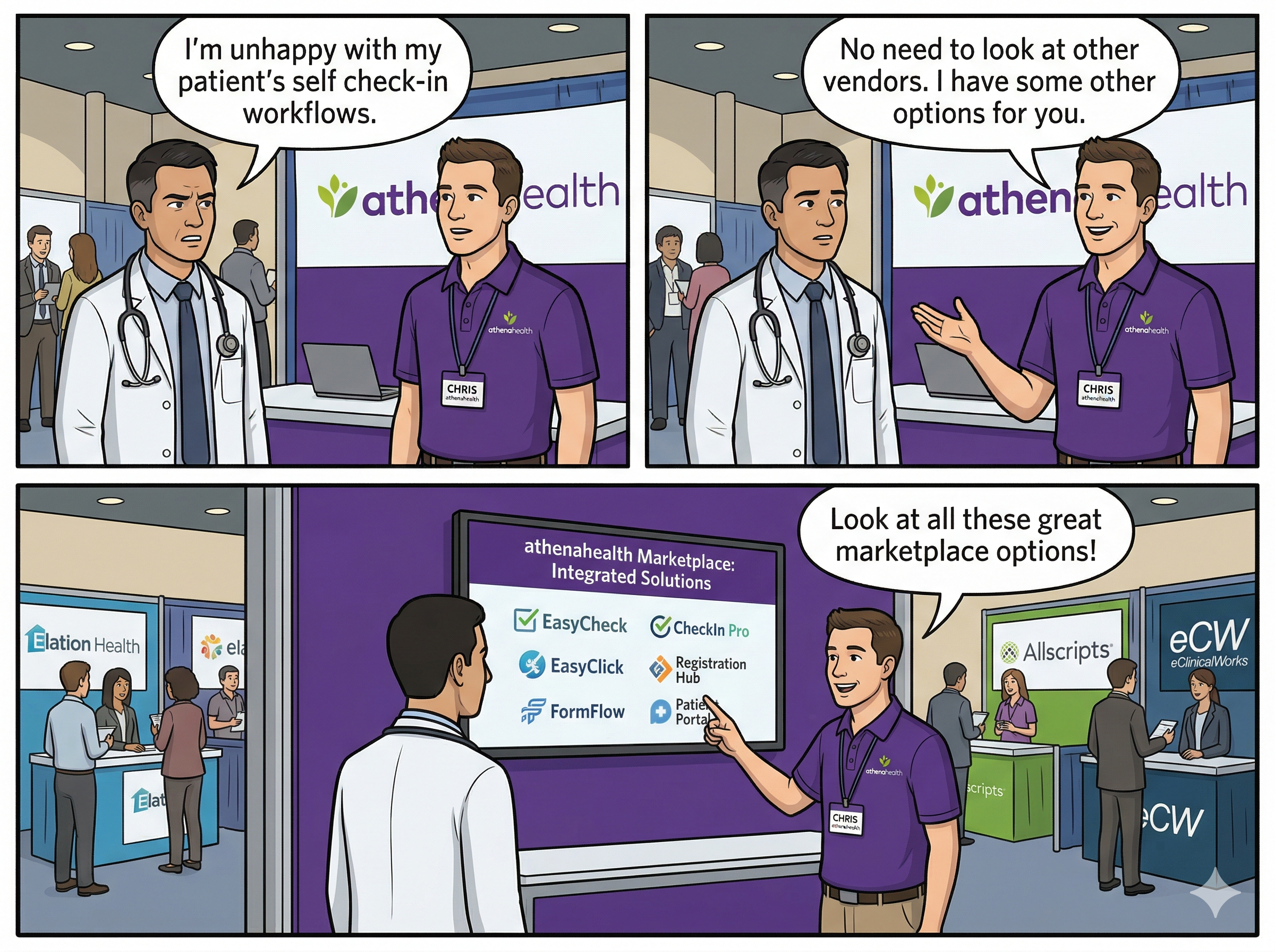
Patient online check-in solutions were the original hot girl at the dance on the athena marketplace. athena hadn't built self check-in functionality and Jonathan Bush was excited about the More Disruption Please program (precursor to the marketplace). The strategy was to let marketplace partners fill the gap. It worked. Phreesia went on to become a public company and Epion, their main competition, was acquired by Kyruus.
Still, customers asked for native self check-in functionality and athena product teams saw a missing puzzle piece in their road map. So a few years later athena built a native self check-in feature. Practices were pumped. They thought they would be able to ditch their self check-in marketplace partner. But that didn't happen.
Why not?
athena's first version of self check-in didn't pull many clients away from the marketplace. It was challenging to set up and had feature gaps. Then in 2022 they released a rebuilt version that was easier to configure, but it ran into architectural constraints around forms. They've continued to iterate, but the gap persists.
athena's APIs are robust enough that marketplace partners could continue appealing to customers through athena’s releases. When the athena team improved social history handling, marketplace partners benefited from that work. Also, athena's internal teams face the same friction any product org does: internal politics, competing roadmaps, the forever balance of bugs vs. infrastructure vs. new features. Open APIs give marketplace partners a meaningful chance to compete.
The real limiting factor for athena was their need to conform to existing standards and workflows across all of their products. Changing those standards would require cross-team collaboration and create downstream impacts across the platform. That constraint hit hardest around forms. And that's where the wedge opened up.
The Wedge
Self check-in has interesting parallels to Voice AI because it's also not a workflow that anyone at the practice does themselves. The practice experiences a good self check-in workflow downstream of the patient doing the check-in. The quality of the workflow is judged by how much work it removes from the staff.
Say there is one type of document that a practice needs a patient to sign, let’s say a custom consent for a medication, and it doesn't play nice with athena's self check-in workflows. For the patient, they do self check-in, fill out all the forms in the portal, then when they get to the practice, they sign one more form. Doesn't feel like a big deal. At their other doctors on Epic, they have to fill out a whole packet of forms every time they come in.
For the practice, this is a huge pain. This one form that doesn't fit into the athena workflow means the front desk person has to print, get a signature, and scan it back into athena. The difference between doing that for 1 form and for 5 forms is negligible for the front desk, so having that one wet signature form prevented them from achieving their goal of a paperless check-in.
That wedge opened up space for marketplace partners, not confined to the architecture restrictions of athena, to build form builders that can make any type of form a practice wants. More than a decade after Phreesia and Epion launched, for many practices, marketplace partners still offer better self check-in workflows than athena. Digital Check-in partners average roughly 100 athena practice connections each, nearly 2x the marketplace average. The top three alone serve over 2,300 practices. That adoption happened alongside athena's own bundled check-in workflows.
This is not a failure by athena. They're playing an ecosystem game. Some practices will choose the built-in functionality and others will go to the marketplace. The 25 Voice AI vendors who joined the marketplace in the last 3 years should take notes.
For athena, it's better to have a practice choosing between athena's AI voice and a marketplace partner's than to lose that practice to Elation. The marketplace exists because athena wants it to. Find the wedge, and make sure it's a valuable one.