Primary care leads athena marketplace installs, but it shouldn't lead your marketing plan
Here's how marketplace installs break down by specialty across the athena platform.
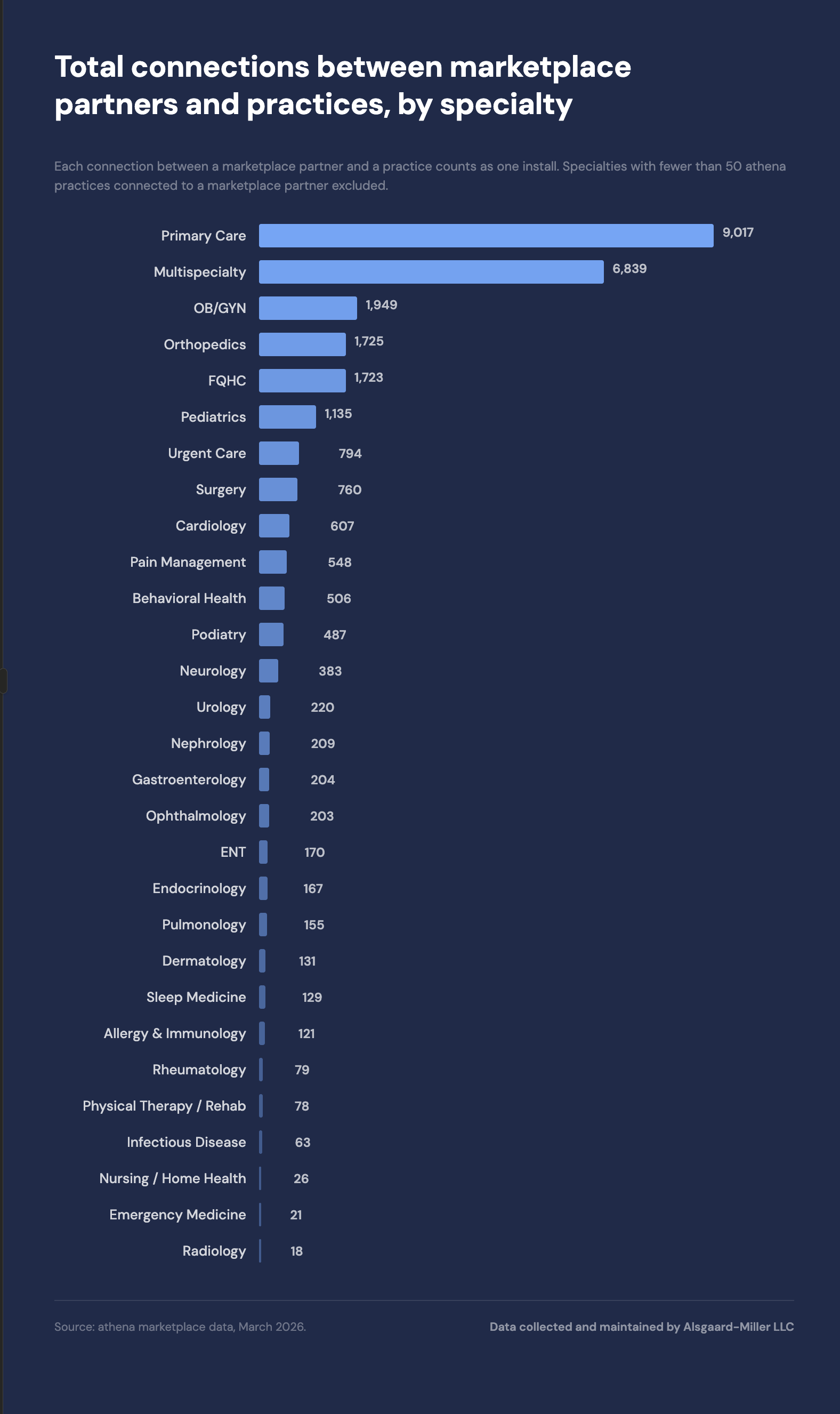
Each connection between a marketplace partner and a practice counts as one install, broken out by specialty.
By absolute numbers, Primary care has the most installs, which makes sense because primary care was athena’s target customer for many years. Does this mean health tech companies should focus on selling to athena primary care groups? No. The raw numbers tell you where the volume is, but they don't tell you which specialties are actually most engaged with the marketplace relative to their share of the athena customer base. When you adjust for how many practices athena has in each specialty, the rankings shift.
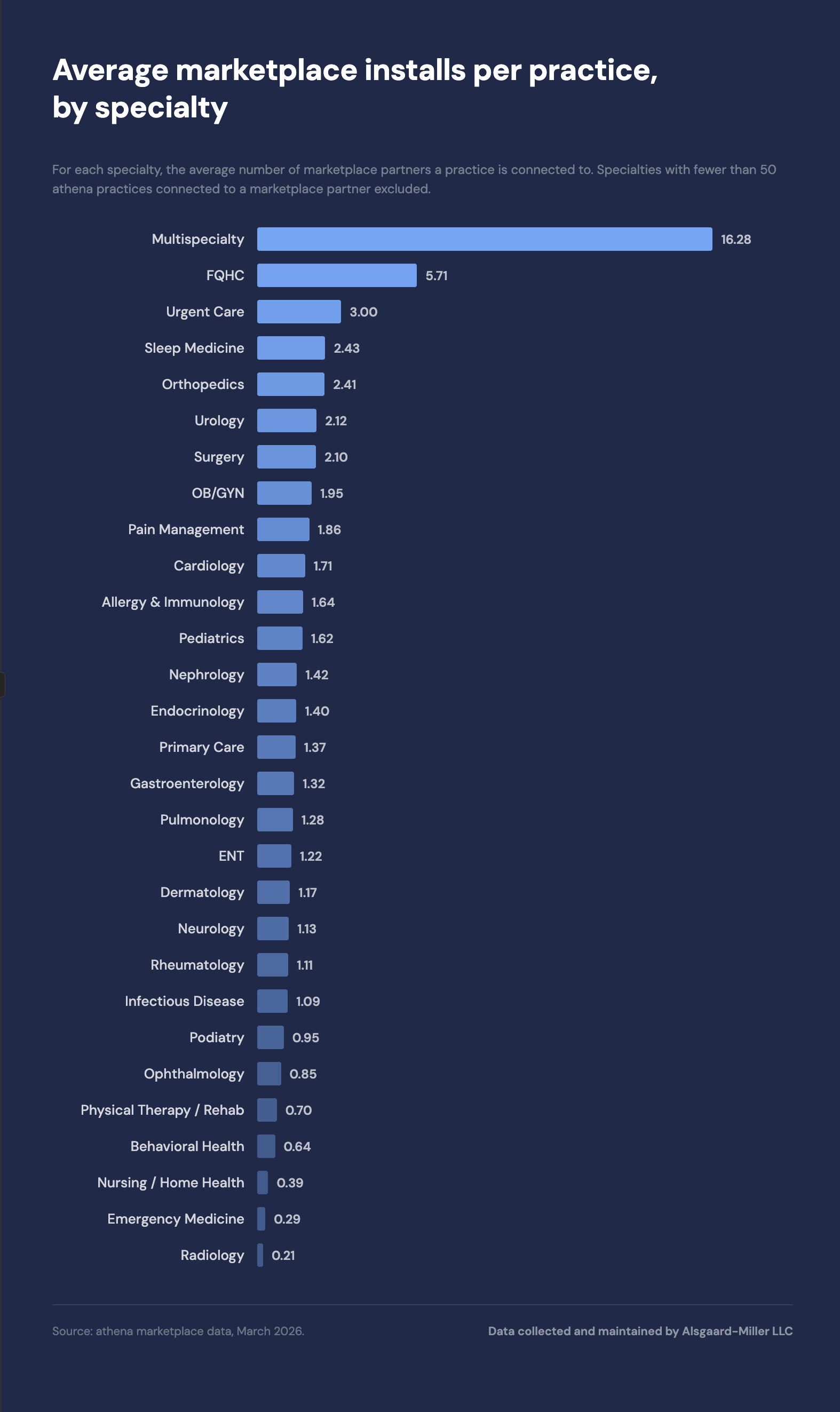
Note: This data has been trimmed to exclude specialties where athena has fewer than 50 practices, otherwise the installs per practice ratio appears artificially high. Those specialties were removed from the first graph too.
In this graph, I've introduced a new metric: Installs Per Practice, the average number of marketplace partners connected to each practice in a given specialty.
In the first graph we saw primary care groups were the top buyers of marketplace partners; however, when we look at the installs per practice data, we see primary care averages 1.37 marketplace partners, dropping them 17th on the list.
Three conditions drive marketplace engagement at the specialty level:
Budget surplus. It's easier to invest in marketplace partners when the practice isn't running on thin margins.
A technology decision-maker on staff. IT, Ops, or a product person: someone incentivized to improve KPIs and available to take a meeting.
A workflow gap athena doesn't solve out of the box. Something specific to the specialty that the core platform handles poorly or not at all.
Here’s how those conditions play out across the top specialties.
Multispecialty
Multispecialty is an outlier. These clinics are larger, and not every department uses the same marketplace partners. Privia has 600+ locations (link to athena case study): just because one location connects a partner doesn't mean the whole network does. That inflates the installs-per-practice number. Multispecialty orgs are still valuable targets. They're brand-name logos that boost your credibility, and if you already have traction in one specialty, a multispecialty client is a good testing ground for expanding into another.
FQHC
Less of a specialty and more of a modality, FQHCs are multispecialty by definition. They have complex care coordination needs along with government reporting requirements which push them toward marketplace partners that offer population management tools and solutions that get patients to actually show up to their appointments.
Urgent Care
Walk-in flow, upfront pricing and payment collection, patient volume management: these are core urgent care operations, and most EMRs handle them as afterthoughts. Urgent cares are also often part of larger ownership groups (sometimes PE-backed), which adds a layer of business people who want reporting and KPI improvement.
Sleep Medicine
Sleep Medicine is an interesting case. Low total installs, but the practices that do engage with the marketplace engage heavily. When I dug into the category data, self check-in and self-scheduling dominated. Scheduling a sleep study is operationally different from scheduling an office visit, and athena's native scheduling doesn't handle that well. When a small specialty has a specific workflow gap, the per-practice engagement can spike.
Orthopedics
As a high-revenue specialty, Ortho practices are more likely to have staff tasked with improving operations. It's a volume business: getting more patients in the door, making appointments more efficient, and getting paid faster are the metrics that matter.
If your athena GTM strategy starts with “primary care, because that's where the volume is,” you're targeting the biggest pool with the lowest per-practice engagement on the platform. The specialties that actually buy are the ones with budget, a tech decision-maker, and a workflow problem athena hasn't solved.