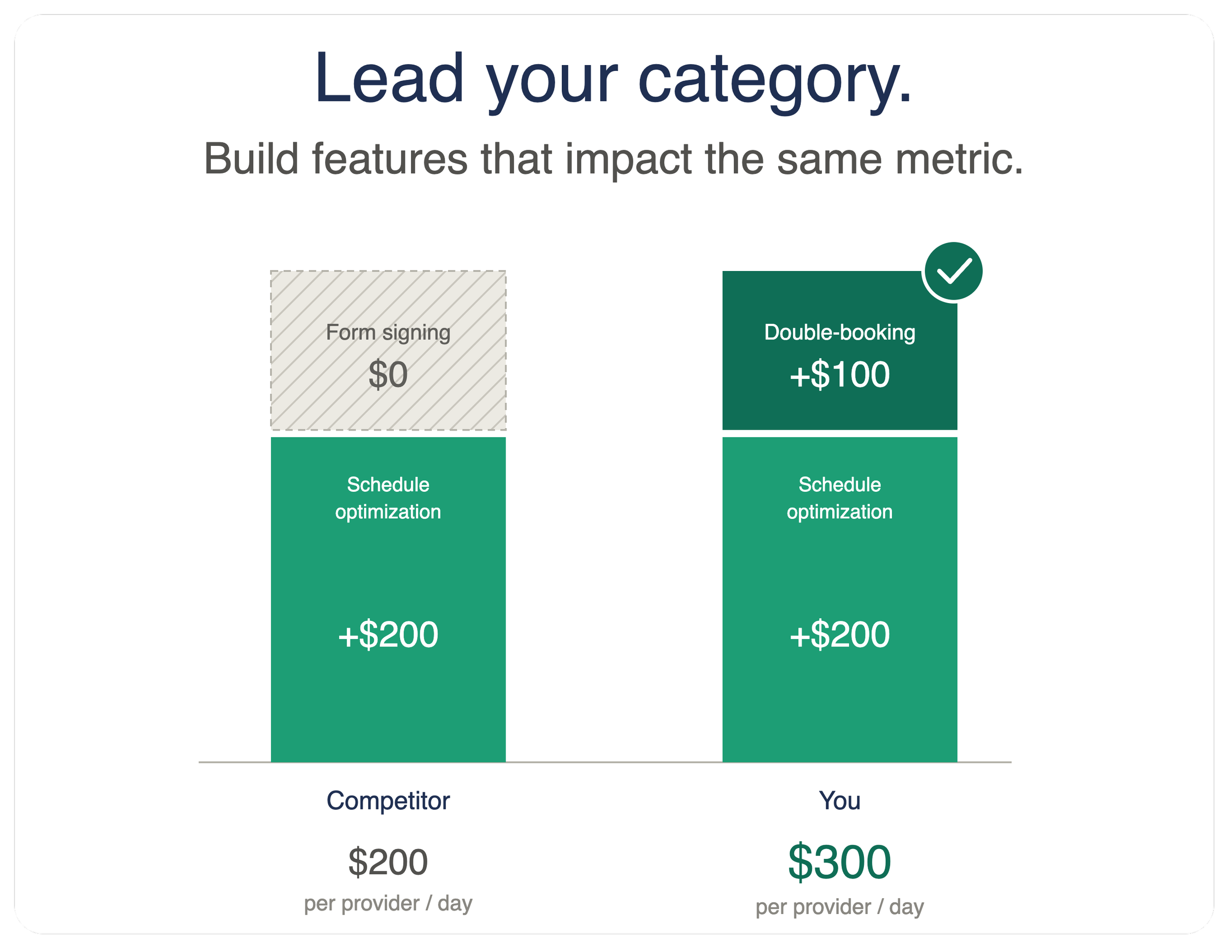
Stack your features on the same metric. It's easier to sell a solution that adds 3 appointments a day than one that adds 2.
Your health tech company started with a killer solution. You increase the volume of appointments at the practice. The tech optimizes the schedule, ensuring canceled appointment slots are filled by an AI agent that contacts patients with future appointments, asking if they want to be seen sooner. Fee-for-service practice owners love it because they’re paid on volume. You take that success story to the next 35 practices and close 10 of them. You get better at telling your story of volume.
Eventually, R&D has worked out most of the bugs and so some R&D folks move on to building new features, a balance between what prospects ask for, what clients want, and if you’re lucky, what is aligned with the founder’s vision. One idea is check-in forms. athena recently released new functionality in this space, but you’ve heard from prospects that it doesn’t solve all their needs. They want their clinic to be paperless, not less-paper.
You’ve used DocuSign. You know you can develop this. Claude Code makes everything faster. If you build it, some of the prospects who asked for this feature will become customers. That’s the goal right?
Let’s ask some questions to assess if you should build the form signing feature.
Should you build the form signing feature?
Does moving form signatures online contribute to the appointment volume metric?
No. It saves the front desk time, which is important, but not aligned with the original story.
Will practices buy form signing functionality on its own?
Maybe. They feel the pain, but it may not be enough pain for lots of practices to purchase a point solution.
Is form signing a better wedge than adding more appointments?
No, form signing saves front desk time, which is notoriously hard to measure in dollars.
How much work is it to set up?
It is not difficult, but it is ongoing. Each form needs to be configured by someone. The practice has to learn a new admin page. When a new practice manager comes in, they have to learn how a different admin page works.
On a site visit with a client, your founder heard that no shows were a growing issue. Patients told the practice they simply forgot they had an appointment. The founder had a hypothesis that if they auto-generated appointment slots to double book appointments where the patient was likely to no-show, 50% of the lost revenue from no-shows could be recovered.
Should you build the double booking feature?
Does it contribute to the appointment volume metric?
Yes, always having a patient ready when the clinic team is in-office increases revenue in a FFS model.
Will practices buy double booking on its own?
Yes, but the standalone impact on metrics will be smaller.
How much work is it to set up?
Not that much. Empty slots are auto-generated at the right times, so the practice follows their normal scheduling workflows.
How easy is it to measure the results?
Easy. You can measure the increase in revenue and the reduction in slots where everyone is at the clinic except the patient.
Since this is an early stage company, I recommend they build the double booking feature. If you sell a point solution, be the best point solution. If a practice that wants to increase appointment volume compares you against another company that increases appointment volume by one appointment per day, you’re more likely to win the business adding 3 appointments per provider per day than 2. Compete on quality, not price.
| Appointment volume (easy to measure) | Front desk time (hard to measure) | |
|---|---|---|
| Schedule optimization | Revenue +$200 per provider per day | Slightly less time for front desk staff to do other tasks |
| Digital form signing | No impact | More time for front desk staff to do other tasks |
| Double book no-shows | Revenue +$100 per provider per day | Slightly less time for front desk staff to do other tasks |
With both features in play, you’re closing lots of deals and even CSMs at athena know you are the partner to mention when practices want to increase appointment volume.